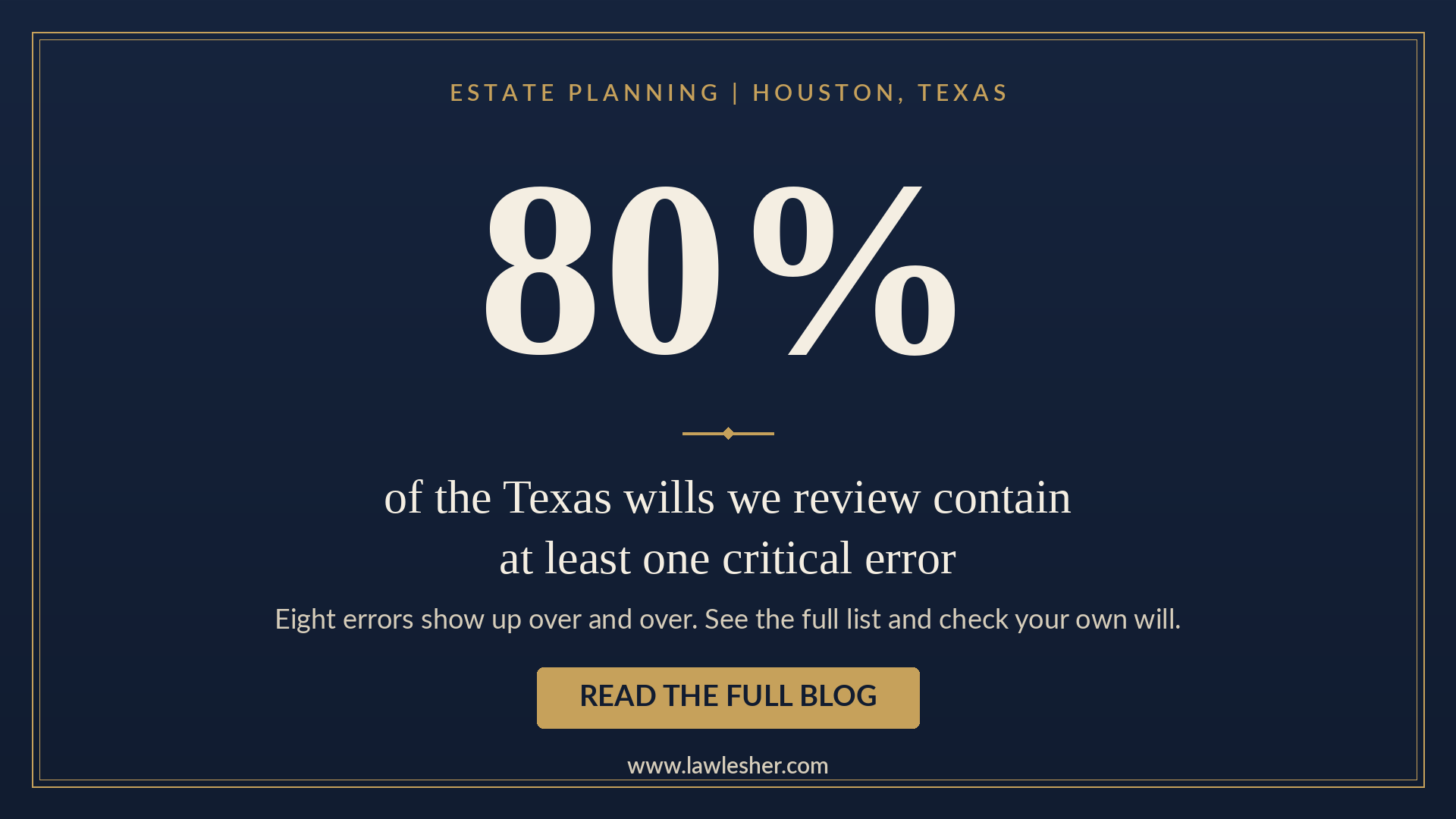




Must Read: 8 Errors Found in 80% of Texas Wills
I Reviewed 100 Texas Wills. Here's What 80% Got Wrong
By Christina Lesher, Attorney | Law Office of Christina Lesher, PC | Houston, Texas
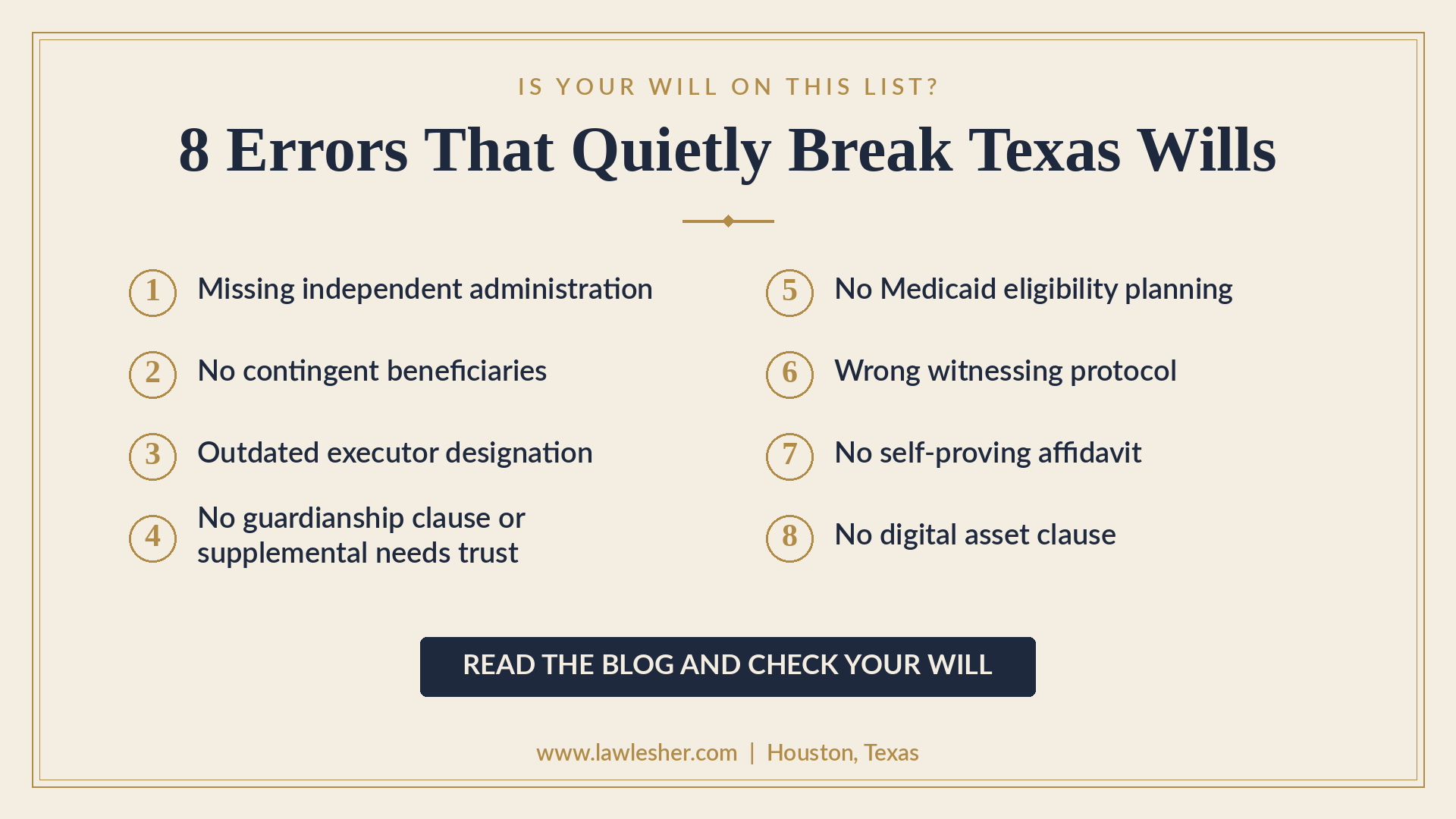
TL;DR: After reviewing thousands of Texas wills, eight errors recur: missing independent administration language, no contingent beneficiaries, an outdated executor, no guardianship clause or supplemental needs trust, no Medicaid eligibility provision, incorrect witnessing protocol, no self-proving affidavit, and no digital asset clause.
Over my career, I have reviewed thousands of wills brought in by new clients. Families sit across from me holding a document they trusted for years. They believed it would protect the people they love. Too often, it will not do the job they hired it to do.
The same eight problems show up over and over. I want to walk through each one, because these are not edge cases.
They are the standard pattern. If your will is more than five years old, or was drafted by an attorney who does not focus on estate planning, there is an 80 percent chance at least one of these applies to you.
None of this is meant to alarm you. It is meant to give you a checklist. Every one of these errors is fixable, and fixing them now costs a fraction of what your family would pay to untangle them later.
What Are the Most Common Errors in Texas Wills?
The most common errors in Texas wills are missing independent administration language, no contingent beneficiaries, outdated executor designations, no guardianship clause or supplemental needs trust for children, no Medicaid eligibility planning, incorrect witnessing, no self-proving affidavit, and no digital asset clause.
Each error has a different consequence. Some cost your family money. Some cost them months in court. Some quietly disinherit the very people you meant to protect. Here is what each one looks like, and what it takes to fix it.
Error 1: Missing Independent Administration Language
A Texas will should expressly authorize independent administration and name an independent executor. Without that language, your estate can be forced into dependent administration, where the court supervises nearly every step.
This is the most expensive error on the list. Texas offers one of the most efficient probate systems in the country through independent administration under Chapter 401 of the Texas Estates Code.
Your executor can pay debts, sell property, and distribute assets with minimal court involvement.
That flexibility only exists if your will asks for it.
When the language is missing, estates get dragged through dependent administration, which can cost ten times more in court fees, bonds, and delays.
Texas law gives you a tremendous amount of flexibility in estate administration, but only if the document is built to use that flexibility. Most wills I review were not.
Error 2: No Contingent Beneficiaries
A contingent beneficiary inherits if your primary beneficiary dies before you. Wills that name only primary beneficiaries can send assets through intestacy, meaning Texas law decides who inherits instead of you.
I see wills that leave everything to a spouse, with no instruction for what happens if the spouse dies first. Couples often pass within a few years of each other.
When the backup plan is missing, the estate falls into the intestacy statutes, and the outcome may look nothing like what the family intended.
Every gift in your will should have a named backup, and ideally a backup for the backup. This takes one conversation and a few added paragraphs. Skipping it can undo the entire plan.
Error 3: Outdated Executor Designation
An outdated executor is a named executor who has died, moved away, become ill, or fallen out of your life. Courts must then appoint someone else, which adds hearings, delays, and sometimes conflict among family members.
Life moves. The brother you named in 2009 may live overseas now.
The friend you trusted may be managing health problems of her own. A divorce may have removed the person you relied on most.
Your executor has real work to do: gathering assets, paying debts, filing with the court, communicating with beneficiaries.
Review the name every few years and after every major life event. If the person you named would not be your choice today, your will needs an update.
Error 4: No Guardianship Clause or Supplemental Needs Trust for Minor Children
A guardianship clause names who raises your minor children if both parents die. A supplemental needs trust protects a child with a disability. Wills missing these provisions leave the most important decisions to a judge who has never met your family.
This is the hardest conversation I have with young parents, and the most important one.
Without a guardianship designation, relatives can end up in court arguing over your children while a judge makes the final call.
For families with a child who has special needs, the stakes are even higher.
Leaving an inheritance outright to that child can disqualify them from essential benefits.
A supplemental needs trust holds the inheritance for the child's benefit without putting eligibility at risk.
It is one of the most protective documents a parent can sign.
Error 5: No Medicaid Eligibility Planning
An inheritance left outright to a person who receives Medicaid can end their benefits. Wills should route that inheritance through a supplemental needs trust so the beneficiary keeps both the gift and the coverage.
This one is huge for special needs families, and it is the error I feel most urgently, because so few general practice attorneys catch it.
A grandparent leaves $50,000 to a grandchild on children's Medicaid. The gift arrives, eligibility ends, and the family spends the inheritance replacing the benefits it destroyed.
The fix is planning, done with a supplemental needs trust drafted into the will itself. The money supplements what benefits provide: therapies, equipment, education, quality of life.
The child keeps the coverage their care depends on. My practice has focused on this intersection of estate planning and benefits law for years, and I can tell you the difference between these two outcomes is life-changing
Error 6: Wrong Witnessing Protocol
Texas requires a will to be signed by the testator and attested by two credible witnesses over age 14, in the testator's presence, under Section 251.051 of the Texas Estates Code. Improper witnessing can invalidate the entire document.
This sounds simple. In practice, I see wills witnessed by one person, wills witnessed by beneficiaries, and wills signed at different times in different rooms. Each of these creates a problem, and some create a fatal one.
A beneficiary who witnesses the will can lose some or all of their gift. A will with one witness may fail entirely.
The signing ceremony matters as much as the words on the page. This is a five-minute procedure when done correctly, and a courtroom fight when done wrong.
Error 7: No Self-Proving Affidavit
A self-proving affidavit is a notarized statement signed by the testator and witnesses under Section 251.104 of the Texas Estates Code. It takes the place of witness testimony in court, so nobody has to track down witnesses years later.
Without this affidavit, your executor may need to locate the original witnesses and bring them to a Houston courtroom to testify that they watched you sign. Ten or twenty years after a signing, witnesses move, forget, or pass away.
The affidavit costs a few extra minutes and a notary stamp at signing.
It saves your family weeks of searching and an avoidable court complication. Nearly every will missing one was signed without an estate planning attorney in the room.
Error 8: No Digital Asset Clause
A digital asset clause gives your executor legal authority to access online accounts, email, photos, and financial apps under Chapter 2001 of the Texas Estates Code. Without it, companies can lawfully refuse your family access.
Your life is online: bank portals, brokerage apps, photo libraries, business accounts, email that receives every statement and password reset. Federal privacy law and provider terms of service block access by default, even for a spouse.
Texas adopted fiduciary access legislation that lets you grant this authority in your will.
Older wills predate the law entirely, and many newer ones simply leave it out. If your will was drafted before 2017, this clause almost certainly is not in it.
How Do You Check If Your Texas Will Has These Errors?
Read your will for the phrases "independent administration," "self-proving affidavit," and "digital assets." Check the executor and every beneficiary name. If anything is missing or outdated, have an estate planning lawyer in Texas review the full document.
You can spot several of these errors yourself in fifteen minutes at your kitchen table.
Others, like witnessing defects and Medicaid provisions, need a trained eye.
A professional review is a short appointment, and it answers the question that matters: will this document actually work when my family needs it?
Frequently Asked Questions
How do I update my will in Texas?
You update a Texas will by signing a codicil or executing a new will, using the same formalities as the original: your signature plus two credible witnesses over age 14. Handwritten changes on the face of a typed will do not work and can invalidate provisions. For most updates, a fresh will is cleaner and safer than a codicil.
What is a contingent beneficiary?
A contingent beneficiary is the person who inherits if your primary beneficiary dies before you or cannot accept the gift. Naming contingent beneficiaries keeps your estate out of intestacy and keeps the decision in your hands instead of the state's.
What is a digital asset clause?
A digital asset clause is will language authorizing your executor to access and manage your online accounts, files, and electronic records under Texas fiduciary access law. It covers email, cloud storage, financial apps, social media, and business platforms.
Do I need to re-sign my will after updates?
Yes. Any change to a Texas will must be re-executed with full formalities: your signature and two qualified witnesses, ideally with a new self-proving affidavit. An updated will that skips the signing ceremony is an invalid will.
Your Will Should Work as Hard as You Did
You built what you have to protect your family. Your will is the instruction manual for that protection, and it deserves the same care you put into everything else.
The families who come through my door are not careless people.
They simply trusted a document that was never built for Texas law, or for the life they live now.
If your will is more than five years old, bring it in. I will review it with you, page by page, and tell you plainly what works, what is missing, and what it will take to fix.
Most reviews end with small, inexpensive corrections and a family that finally knows their plan will hold.
Call our office to schedule a will review, or visit us on Kirby Drive.
We serve families across Houston, Bellaire, West University, Braes Heights, Braeswood, and The Woodlands.
Law Office of Christina Lesher, PC
5615 Kirby Dr, Suite 412, Houston, TX 77005
Phone: 713-529-5900
Web: www.lawlesher.com

About the Author: Christina Lesher is a Houston elder law and estate planning attorney and the founder of the Law Office of Christina Lesher, PC. A licensed social worker before becoming an attorney, she brings both legal precision and human warmth to wills, trusts, probate, Medicaid planning, and special needs planning. She is one of a small number of Texas attorneys with deep expertise in children's Medicaid eligibility.