



Children's Medicaid in Texas: 2026 Guide for Special Needs Families
TL;DR: Children's Medicaid in Texas covers doctor visits, therapies, prescriptions, and equipment for children who qualify by family income or by disability. For a child with special needs, the coverage is often irreplaceable, and it can be lost through an unplanned inheritance or gift.
Supplemental needs trusts and ABLE accounts keep benefits safe.
Medicaid is the area of law I care about most, because so few attorneys work in it and so many families depend on it. This guide covers what the program does, how to access it, and the planning that keeps it safe.
What Is Children's Medicaid in Texas?
- Comprehensive health coverage for both children under and over 18 through Texas Health and Human Services
- Covers checkups, specialists, therapies (speech, occupational, physical), prescriptions, hospital care, dental, vision, and medical equipment
- For many special needs children, it funds services private insurance caps or excludes
To learn more, visit our Caregiver Tool Box by clicking here.
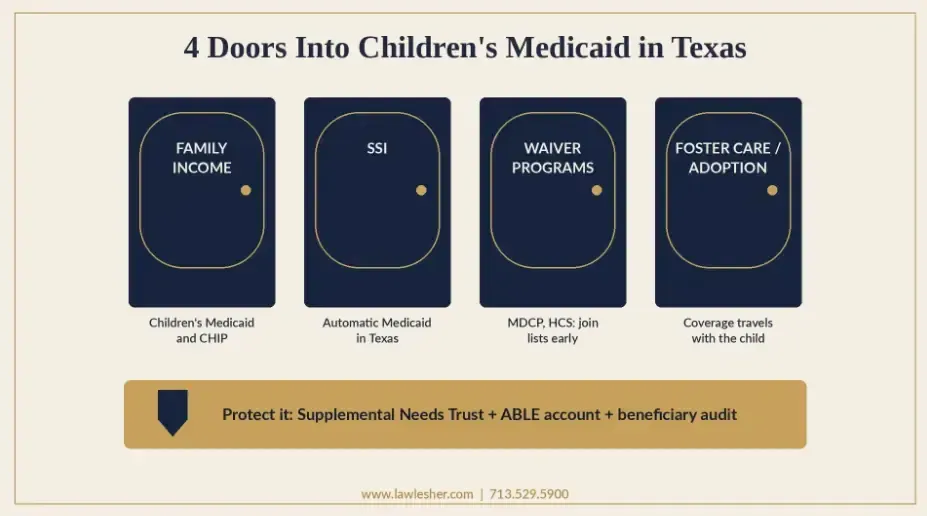
The 4 Doors Into Medicaid Coverage
- Family income: Children's Medicaid for lower-income households; CHIP sits just above it
- SSI: A child who receives Supplemental Security Income gets Medicaid automatically in Texas - usually after turning eighteen.
- Waiver programs: programs like MDCP- Medically Independent Children Program and HCS-Home and Community Services can qualify a child based on the child's needs, with waiting lists that reward early action; interest lists can run years long, so sign up now
- Foster care and adoption assistance: children in these systems carry Medicaid with them
Why Benefits Are Fragile: The 3 Common Ways Families Lose Them
- A grandparent leaves an inheritance directly to the child
- A parent's will has no supplemental needs trust or names the child as a beneficiary on a financial account, so the child inherits outright at death
- Well-meaning relatives put savings or UTMA accounts in the child's name
Each one can push a child over asset limits and end SSI-linked coverage until the money is spent.
The 3 Tools That Protect a Child's Medicaid Benefits
- Supplemental needs trust: holds any inheritance for the child's benefit without counting against eligibility; the essential estate planning tool for special needs families
- ABLE account: a tax-advantaged savings account for disability expenses that shelters modest amounts without a trust
- Coordinated beneficiary designations: life insurance and retirement accounts must point to the trust, never to the child directly
What Parents Should Do This Year
- Join waiver interest lists now, even if you doubt you will qualify
- Audit every account and policy naming your child
- Add a supplemental needs trust to both parents' wills
- Write a letter of intent describing your child's routines, providers, and needs
Children's Medicaid FAQ'S
Who qualifies for Children's Medicaid in Texas?
Children under 18 in families meeting income limits, children receiving SSI, children in certain waiver programs, and children in foster care or adoption assistance.
Can a child on Medicaid receive an inheritance?
Not directly without risking benefits. An inheritance routed into a supplemental needs trust preserves both the gift and the coverage.
What is the difference between CHIP and Children's Medicaid?
Both cover Texas children. Medicaid serves lower-income families with broader benefits; CHIP serves families slightly above Medicaid limits with modest cost sharing.
What is a supplemental needs trust?
A trust that holds assets for a person with a disability to pay for extras like therapy and equipment while keeping Medicaid and SSI eligibility intact.

I am one of a small number of Texas attorneys focused on children's Medicaid. If your child depends on these benefits, let's protect them properly: 713-529-5900.

About the Author: Christina Lesher
Christina Lesher is a Houston elder law attorney with over 25 years of experience in elder care, social work, and legal services. Since 1997, she has helped families navigate Medicaid planning, estate planning, probate, guardianship, and special needs planning. Drawing on her personal experience caring for her grandfather with dementia, Christina combines legal knowledge with compassionate, hands-on guidance to help Texas families protect their loved ones and plan for the future.